Wednesday, September 11, 2013

Stephen C. Meyer has it wrong

Dr. Stephen C. Meyer is the director of the Discovery Institute's Centre for Science and Culture, and is a regular guest on the Michael Medved Show's weekly Science & Culture Update (that should probably be "weakly Science..."). It's a show where Michael proclaims that America is the "greatest country on God's green earth", and they moan about how big-science is bullying intelligent design (ID), and that science is closed-minded because it limits itself to only natural causes. People call in desperately trying to educate Dr. Meyer on why ID is not science. It amazes me that Dr. Meyer has a Ph.D. from Cambridge in Philosophy of Science, and yet can't see how allowing magic into the scientific discourse would cause problems.

He insists that ID is not just a negative case of pointing how evolution is an insufficient explanation, but that ID is a positive scientific statement, "based on what we know, not on what we don't know". He says,
there is a cause of which we know that is capable of building the kind of information that we see arising in the history of life, in the Cambrian period, for example. And that cause is intelligence.
Dr. Meyer likes to say that he bases his conclusions on a standard method of scientific reasoning, called "inference to the best explanation".
Darwin had a principle of reasoning that he also used which was called the vera causa principle. The idea is that when you're trying to explain an event in the remote past you should look for causes that are now in operation, causes that are known to produce the effect in question. Well, as I was studying that in graduate school I asked myself the question, What is the cause now in operation that produces digital code, that produces circuitry? And the answer from our uniform and repeated experience is intelligence.
From that, he concludes that an intelligent being created life and the universe.

Here's the problem. According to his logic, we should conclude that humans created life and the universe, since our uniform and repeated experience tells us that humans create digital code and circuitry. We certainly have no uniform and repeated experience of gods creating digital code. Nor do we have any uniform and repeated experience of unembodied intelligent agents designing circuits. Just humans.

So, by Dr. Meyer's logic, we should conclude that humans created life and the universe. Done.

You'll be relieved to hear that this logic is faulty. No, you are not responsible for creating yourself and all your friends.

Dr. Meyer implies that the best explanation of the order we see in the universe is intelligence. But why is that the best explanation? Who says? I admit that it's satisfying in an intuitive sense... we deal with intelligent agents all the time (other people), so what's the problem with adding just one more?

However, the universe is not there to satisfy our intuitions. It can contradict our intuitions quite happily, thank you very much. So, intuitions aside, how might we gauge a good vs. bad explanation? Probability. The most probable explanation could be considered the best explanation.

Question: What is the probability that an unembodied, timeless intelligent agent created the universe and designed the life therein?

Answer: Hard to say, since we really have no basis for comparison.

Question: What is the probability that humans mistakenly believe the universe was created by an intelligent agent?

Answer: Well, on this topic we have lots of data. Human psychology is full of examples of delusion, many of them clearly anthropomorphic in nature. Humans used to believe that thunder and lightning were the gods getting angry. Those who believe they've seen aliens usually draw them as humanoid. Look at all the different religions, each with its own human-like god (or gods). It's clear that humans are susceptible to anthropomorphic delusions.

Darwin showed us that information and design can emerge by natural causes.

So, what is your inference to the best explanation? A magic, invisible, unembodied, intelligent creator? Or the operation of natural causes, viewed through a distorted human lens?

Friday, May 17, 2013

Discovery Institute's Wet Dream

I've been listening to I, Charles Darwin on the podcast Intelligent Design the Future. It's a novella written by Nickell John Romjue. The premise is interesting, that Charles Darwin is magically brought back to the world to see how his theory changed history. He tours through space and time, and -- of course -- concludes that modern science has it all wrong.

I disagree with the book's portrayal of Darwin. It puts words in his mouth, words that he would never say, in my humble opinion.

For example, when he finds out about the Nazi holocaust, he's sad that his theory of evolution by natural selection has lead to eugenics.

Yah, his theory lead to eugenics in the same sense that particle physics lead to the atomic bomb. The science is not the problem. Sociopolitical policy is the problem. Science doesn't make bombs; people make bombs.

The whole series is a wet dream for those who don't want to believe in evolution. It's like me writing a book in which Jesus comes back to Earth and says, "Hey man, I was just joking! I'm not the son of God. There is no god!"

Based on his books, I would expect Darwin to be an atheist if he were alive today. He posited that because all living things are related, they differ only in degrees, not in fundament. His book The Descent of Man was even more direct, applying the theory of evolution to humans. It outlines the ways in which humans are animals, and how our evolutionary heritage shaped what we are today. This is a message that many religious people do NOT want to hear because it contradicts the explanations offered by holy books.

The novella, I, Charles Darwin is simply a wishful-thinking propaganda tool for the religious right-wing. It's pure fiction.

Tuesday, April 16, 2013

Debunking Douglas Groothuis' Argument

On April 5, 2013, Jeff Shallit pointed out a blog post by Douglas Groothuis, a Professor of Philosophy at Denver Seminary. Prof. Groothuis' post was entitled "A Moral Case Against Darwinism". Here is an executive summary of Prof. Groothuis' argument.
  1. If evolution is true, then there is no philosophical basis for objective and universal human rights
Admittedly, the full argument is longer, but unnecessarily so, in my opinion. I actually agree with that statement.

But then he continues, asserting that statement (1) above is false. What I think he means is that the conclusion is false, since he says there IS a philosophical basis for objective and universal human rights.

And according to the rules of logic,
Given A->B
And ~B
We conclude ~A
In other words, the premise evolution is true is incorrect, and we conclude that evolution is false.

His rationale for rejecting the conclusion is that
Our moral intuitions and the history of Western law treat every human being, irrespective of race, as possessing intrinsic human dignity and must be treated as such.
It's true, we tend to have such intuitions and laws. But it does not negate the conclusion. Laws about equality are not a definitive philosophical basis for objective and universal human rights. Such laws can exist despite there being no philosophical basis.

And that leads me to my second point. Prof. Groothuis actually claims that an if-then statement is false. The logical negation of an if-then statement A->B is (A and ~B). That is, A is true, but B is false. This is basic logic.

Negating statement (1) means that evolution is true and there IS a philosophical basis for human rights.

However, I highly doubt that's what Groothuis means, since he's trying to show that evolution is false.

I submitted a comment to his blog, but unfortunately Prof. Groothuis said he "can't find the comments to post them". I guess things have changed since January 17th when he did post the comments on his blog.

So I thought I'd help him out by posting my own critique on my own blog. I wonder if Prof. Groothuis will respond on his blog?

Thursday, March 21, 2013

Intelligent Design - Is it science?

I'm so excited about this talk scheduled for Thursday March 28, 5:30pm. The lecture is organized by AAFW, the Atheists, Agnostics and Freethinkers of Waterloo.

Prof. Jonathan Witt will be speaking. He is a professor in biology.

You can find out more on the facebook event page.

Will I see you there?

Wednesday, March 20, 2013

God and Reason part 8: "The Next Step"

I attended the 8th, and last lecture of the God and Reason course. This one was focussed on "The Next Step". Prof. John North spoke again, and his talk was very easy to listen to, very engaging.

The talk was really a bunch of stories tied together with a few concepts. That's a great way to get a message across... I really want to learn from these. But the appropriateness of that style depends, perhaps, on what your message is. If your goal is to outline a sequence of facts in the derivation of a proof, then the stories -- while entertaining -- will slow you down too much. But if your goal is to convey a more intuitive message, stories are the way to go.

And that leads me to my overall impression of this lecture series.

It seems obvious now that the series was not meant as a scientific or critical appraisal of Christianity, but rather as an exercise in persuasion. The talks tended to be short statements of opinion interleaved with emotionally-charged stories, sprinkled with scant cherry-picked facts thrown in for good measure. This is not how we discover truth, but rather an effective way to sway opinion. In many respects, they might as well have been up there extolling the virtues of Coca Cola over Pepsi. Really! Just swap out any reference to the Bible or God, and replace each with something about secret recipes and personal taste.

Here is an example of the persuasive argument. Prof. North started to push our guilt button in this talk. He made everyone feel guilty for having so much opportunity (yes, we are lucky to live in Canada). He told a story about Ethiopian Christians trying to escape through Sudan, some being caught in Egypt and sent to be tortured. He said that we are all guilty of sin and that without forgiveness guilt will destroy us. He offered no evidence for that assertion, but merely stated it as incontrovertible fact. The solution, according to Prof. North, is to give yourself to Jesus, since the only punishment big enough for our sins is Jesus' death on the cross.

The Ethiopian story is very scary, true. But what does it have to do with the question of God's existence? If anything, that story tells me that we need to stop people from seeing the world through the lens of their own religion. We all share a common humanity. We do NOT all share the same religion.

It is my understanding that a public university like Waterloo should exercise critical thinking in all of its sanctioned activities. This course did not achieve that standard. Instead, it was an exercise in persuasion, promoting a single ideology. This is a course I'd happily fail.

Wednesday, March 13, 2013

God and Reason part 7: "Could there be just one true religion?”

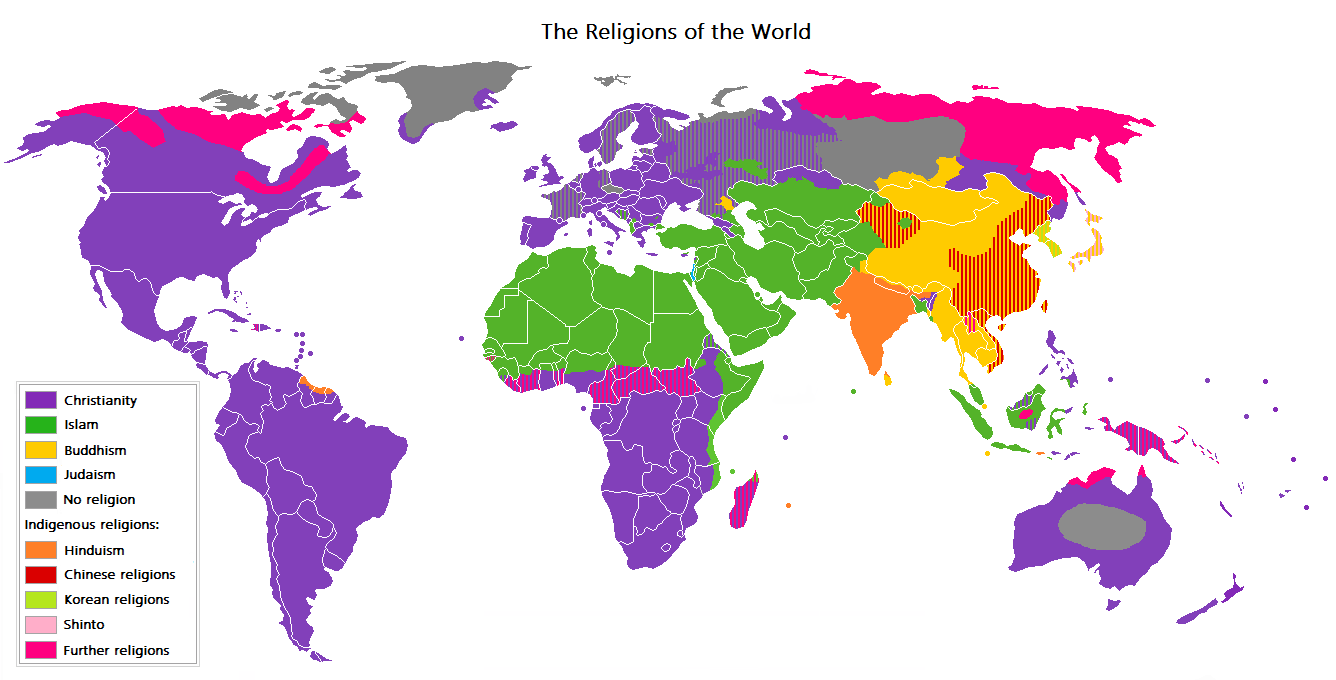
Distribution of religions
Wayne Brodland spoke again, and explained that his focus would be on 4 of the main world religions: Islam, Hinduism, Christianity, and what he called "Just-do-it-yourself-ism" (basically, a catch-all category for those who don't take orders from a god or gods).

He went over the various possibilities:

  1. All religions are true
  2. Several religions are true
  3. One religion is true
  4. No religions are true
He pointed out that 1 cannot be the case, since many religions categorically contradict each other. He gave the example of Islam (only one god) vs Hinduism (many gods).

Then he addressed option 2, that several of the religions could be true. In this case, one could build a set of religions that are logically consistent (don't contradict each other). But, as it turns out many religions have exclusivity assertions, like "No one comes to the Father except through me" (John 14:6). So even option 2 seems infeasible.

So we're left with options 3 and 4, that there is only one true religion, or all religions are false.

Concerning option 4, that all religions are false, Prof. Brodland offerred the rock-hard evidence that it "seems improbable to me."

So option 3 it is! Now which religion is the one true religion?

Prof. Brodland brought up the claim that he treats his religious beliefs with the same critical rigour as his scientific beliefs.

A couple times, Prof. Brodland pointed out that God gives us enough evidence that we should follow him, but not so much that we are logically forced to. I find this argument silly, like shooting an arrow into the side of a barn and drawing a target around it. There will always be assertions that are difficult to resolve as true or false. All one has to do is plant their god neatly in the middle of it. And as science resolves some of these questions, religions that don't update their god's opinions get tossed into the rubbish-bin of history; the earth revolves around the sun, the universe is billions of years old, lightning is electricity.

Prof. Brodland then gave us his reasons for why he is a Christian.
  1. His observations of the beauty and order in the world are compelling.
  2. The credibility of the Bible. Here he compared the Bible to a peer-reviewed journal.
  3. Dialog between us and God
  4. Personal experiences
  5. Best explanation for fitting the pieces together
I really don't know what he means by 3, so I won't touch it. Numbers 1 and 4 are utterly subjective, so don't apply to me or anyone else. I addressed the credibility of the Bible in a previous post; in my opinion (as an outsider), the Bible is no more credible than any other holy text. And as for number 5, I disagree emphatically. I think there are much more objectively sound, and interesting explanations for religious beliefs and the evolution of religion.

He pointed out that even in science, we can't always build a water-tight case. That's true. Technically speaking, we can't prove anything scientifically. But we can disprove things. That's because proper scientific claims are falsifiable. 

During the question period, I asked if he agreed that many of the claims made by religions are unfalsifiable. He more-or-less agreed. The reason I asked was because I find it ridiculous that a critical thinker can claim to have weighed the evidence of their religion against others, and found that their religion is the best of them all. All religions make unfalsifiable claims. And how - exactly - does one decide which unfalsifiable claim is more true than the others? You can't... that's the problem with unfalsifiable claims.


Wednesday, March 6, 2013

God and Reason part 6: "Who was Jesus?"

Today's speaker was Wayne Brodland, a Professor of Civil Engineering whose specialty is the mechanics of living tissues. I've encountered his work before, and was impressed. And he is - as are all the speakers in this series - an award-winning teacher.

He started his talk drawing a parallel between how he approaches his lab work, and how he approaches his Christian faith. He said that he uses the same processes to discover truth in both arenas. It's a cycle involving data, theory, testing, critical analysis, and reformulation.

Prof. Brodland asked, "How do we collect data?" He showed a slide that looked something like this:
We collect data through our senses (and related instruments). For this, we use our bodies. We use logic, which he attributes to the soul (though he conceded that the brain is involved). The vertical arrow labelled "Methodological Naturalism" indicates which types of data are acceptable in science.

He said we also get data from revelation, through the Bible. He says this gives the religious an additional source of information, an advantage. Does that mean that religious people have the upper-hand on truth and reality? Not so fast.


Prof. Brodland then went into a pseudo-statistical hypothesis test.
Hypothesis: Jesus rose from the dead.
Null Hypothesis: Jesus did not rise from the dead.
He offered three lines of evidence in opposition to the null hypothesis: the empty tomb, witness accounts, and the changed attitudes of Jesus' followers. All of the arguments were based on assumptions as tenuous as the hypothesis itself: reports that people saw Jesus after his death, the alleged absence of corrections to the story, the motivation of the Jews to keep the body in custody, the choice of the disciples to continue Jesus' teachings even though it exposed them to horrific treatment. He said these all refute the null hypothesis. Hence, Jesus most likely rose from the dead. QED

During the question period, I (again) brought up the point that witness testimony is well known to be problematic (many people claim to have seen Elvis after his death). The truth of these Bible stories relies heavily, HEAVILY on witness testimony. Moreover, it is obvious that motivated theologians could have contributed their own spin in the intervening centuries.

Prof. Brodland answered that the current gold-standard for evidence in the court room is witness testimony. He said it's the best evidence we have. I disagree. Eyewitness testimony should NOT be the gold-standard. Physical evidence (DNA, fingerprints, textile fibers) is more objective and quantifiable.

Wayne shared with us a story of when he suddenly lost his hearing, and the doctors didn't know why. He told us the doctors expected it was due to neurological damage, and would not improve. Prof. Brodland and his friends prayed for his hearing to return, and after some time it improved. Wayne's conclusion? God fixed his hearing. This is an excellent example of the correlation vs. causation logical fallacy. They prayed, then his hearing returned.

I was going to challenge Prof. Brodland on this interpretation, but Jeff Shallit beat me to it. And a good thing... amazingly, Jeff said that he had a very similar episode of hearing loss. The doctors didn't know the cause. But his hearing came back... even though he didn't pray. Spontaneous remission does occur. (read Jeff's perspective)

Prof. Brodland said that he didn't know Jeff's medical history, but he knew his own. When Jeff tried to respond, Wayne cut him off and said, "It's a personal story, and that's just the way it is."

I can appreciate that losing one's hearing is traumatic. But I can almost guarantee that Prof. Brodland does not treat his religious sensibilities the same way he treats his lab. Confusing correlation with causation would get you laughed out of the peer-review process. It's an amateur mistake to make. And I expect Wayne would not tolerate it in his lab work.

Wayne repeated that personal experiences were strong pieces of evidence for him. For him. Well, what are we supposed to do with that, if it only applies to him? A subjective proof is no proof at all. It might as well be a story about gnomes and unicorns.

He said it's like grandma's cookies, you have to taste them to understand how good they are. I guess he's suggesting we all get hooked on heroine so we can understand, first hand, what is so compelling to turn good people into junkies. Who wants to go first?