
 |
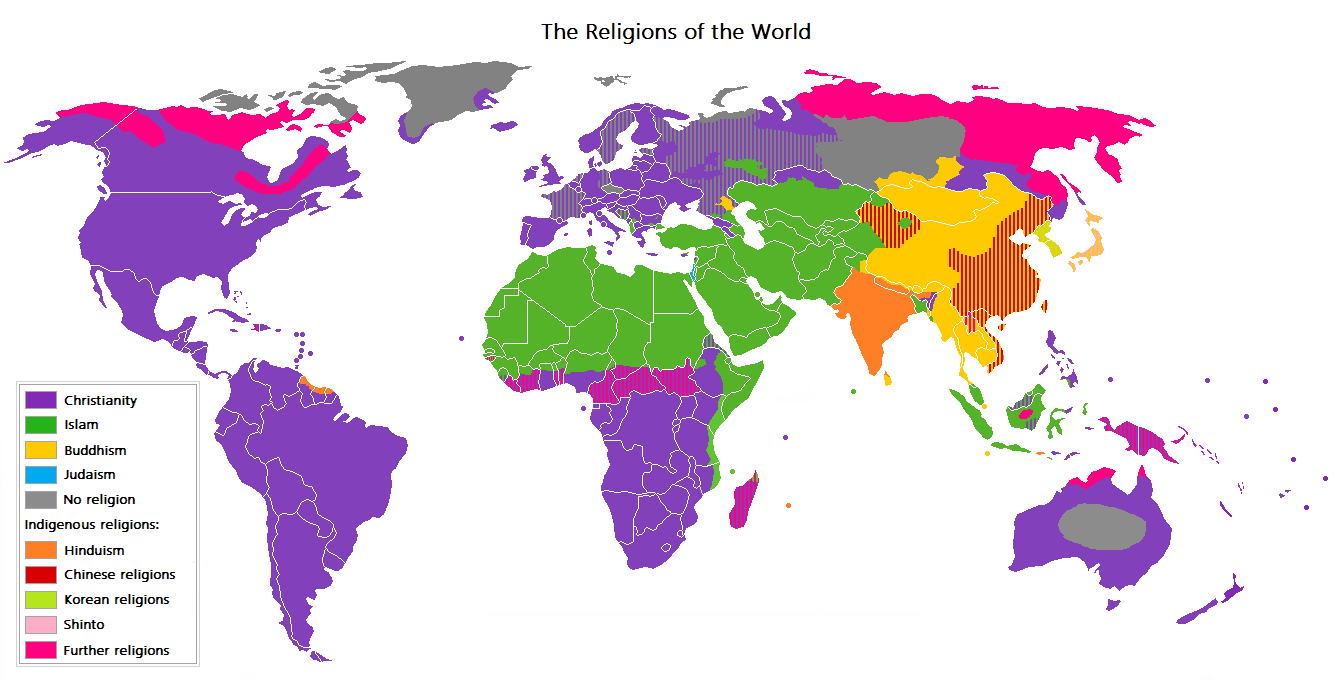
| Distribution of religions |
He went over the various possibilities:
- All religions are true
- Several religions are true
- One religion is true
- No religions are true
He pointed out that 1 cannot be the case, since many religions categorically contradict each other. He gave the example of Islam (only one god) vs Hinduism (many gods).
Then he addressed option 2, that several of the religions could be true. In this case, one could build a set of religions that are logically consistent (don't contradict each other). But, as it turns out many religions have exclusivity assertions, like "No one comes to the Father except through me" (John 14:6). So even option 2 seems infeasible.
So we're left with options 3 and 4, that there is only one true religion, or all religions are false.
Concerning option 4, that all religions are false, Prof. Brodland offerred the rock-hard evidence that it "seems improbable to me."
So option 3 it is! Now which religion is the one true religion?
Prof. Brodland brought up the claim that he treats his religious beliefs with the same critical rigour as his scientific beliefs.
A couple times, Prof. Brodland pointed out that God gives us enough evidence that we should follow him, but not so much that we are logically forced to. I find this argument silly, like shooting an arrow into the side of a barn and drawing a target around it. There will always be assertions that are difficult to resolve as true or false. All one has to do is plant their god neatly in the middle of it. And as science resolves some of these questions, religions that don't update their god's opinions get tossed into the rubbish-bin of history; the earth revolves around the sun, the universe is billions of years old, lightning is electricity.
Prof. Brodland then gave us his reasons for why he is a Christian.
- His observations of the beauty and order in the world are compelling.
- The credibility of the Bible. Here he compared the Bible to a peer-reviewed journal.
- Dialog between us and God
- Personal experiences
- Best explanation for fitting the pieces together
I really don't know what he means by 3, so I won't touch it. Numbers 1 and 4 are utterly subjective, so don't apply to me or anyone else. I addressed the credibility of the Bible in a previous post; in my opinion (as an outsider), the Bible is no more credible than any other holy text. And as for number 5, I disagree emphatically. I think there are much more objectively sound, and interesting explanations for religious beliefs and the evolution of religion.
He pointed out that even in science, we can't always build a water-tight case. That's true. Technically speaking, we can't prove anything scientifically. But we can disprove things. That's because proper scientific claims are falsifiable.
During the question period, I asked if he agreed that many of the claims made by religions are unfalsifiable. He more-or-less agreed. The reason I asked was because I find it ridiculous that a critical thinker can claim to have weighed the evidence of their religion against others, and found that their religion is the best of them all. All religions make unfalsifiable claims. And how - exactly - does one decide which unfalsifiable claim is more true than the others? You can't... that's the problem with unfalsifiable claims.

